
Pay
Payroll & statutory compliance
One run. Every statutory number calculated, and every one traceable.
Payroll is where an HRMS either earns its keep or creates a second job. EZER calculates gross, deductions, employer contributions and every applicable statutory head in a single pass — from the attendance you already captured, against the salary structure you already configured.
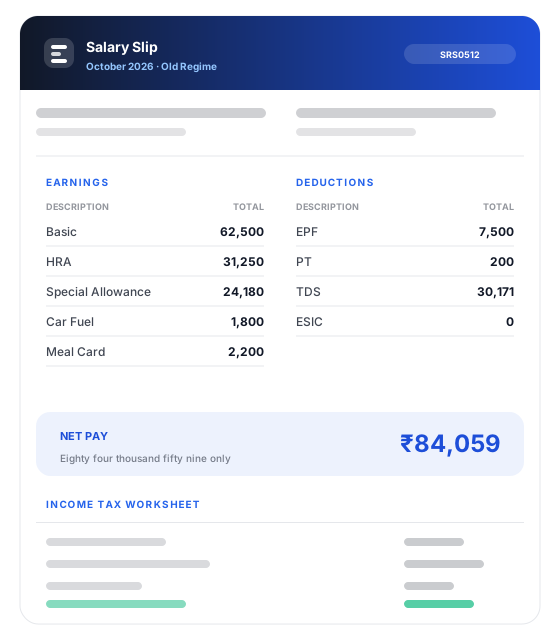
Without a system
How this gets done today
Without a system, month-end is a chain of spreadsheets. Attendance comes off a biometric export, the salary sheet is built by hand, and EPF, ESIC, PT and TDS are each worked out in their own tab.
Every one of those handoffs is a place for a number to change. The register is reconciled twice because nobody quite trusts it the first time, and when an employee disputes a deduction there is no calculation to point at — only a cell.
What it does
Inside payroll & statutory compliance
A run you can reverse
Lock attendance, calculate, review the variance against last month, then release. Nothing is final until you release it, so a mistake found on the 29th is a re-run, not a correction cycle.
EPF, exactly as the act requires
Employee and employer contribution, the EPS split, admin and EDLI charges, and wage-ceiling handling for members above and below the limit. ECR-ready output.
ESIC with contribution-period rules
The wage ceiling, mid-period crossings and the rule that an employee who crosses mid-period stays covered to the end of it — handled, not left to whoever remembers.
Professional Tax, state by state
PT slabs configured per state and applied by the employee’s work location, so a company operating in five states runs one payroll, not five.
LWF at the right frequency
Labour Welfare Fund varies by state in both rate and frequency — monthly, half-yearly, annual. Configured once per state registration.
TDS across both regimes
Old and new regime, declarations, verified proofs, a month-on-month projection that updates as the year progresses, and Form 16 at the end of it.
Arrears that reach backwards
A retrospective increment recalculates the affected months and carries its statutory effect with it, rather than being dropped in as a lump sum that breaks the PF reconciliation.
Full & final in one settlement
Notice period, leave encashment, gratuity, loan recovery and pending claims resolved together, with the statutory deductions applied to the settlement itself.
Built for India
What EZER does for each statutory head
Not a global payroll tool with an India patch. Each act below is handled inside the run, against configuration that reflects your registrations.
| Act | What the system does | Basis applied |
|---|---|---|
| EPFEmployees’ Provident Funds & Miscellaneous Provisions Act, 1952 | Calculates employee and employer contributions, splits the employer share between EPS and EPF, applies the wage ceiling for eligible members, adds admin and EDLI charges, and produces ECR-ready output. | 12% employee · 12% employer, split EPS/EPF · ₹15,000 wage ceiling |
| ESICEmployees’ State Insurance Act, 1948 | Applies the wage ceiling, handles employees who cross it mid-contribution-period by keeping them covered to the end of that period, and produces return-ready output. | 0.75% employee · 3.25% employer · ₹21,000 wage ceiling |
| PTState Professional Tax Acts | Holds slabs per state, applies them by the employee’s work location, and handles the states with a different rate in a specific month. | State-wise slabs · ₹2,500 per year constitutional maximum |
| LWFState Labour Welfare Fund Acts | Applies the contribution at the rate and frequency the relevant state requires — which may be monthly, half-yearly or annual — per registration. | State-wise rate and frequency |
| TDSIncome Tax Act, 1961 — salary TDS | Runs both the old and new regime, takes declarations and verified proofs, projects tax across the remaining months of the year, and issues Form 16. | Old and new regime · monthly projection · Form 16 |
| NPSEmployer contribution under section 80CCD(2) | Handles the employer NPS contribution inside the salary structure, with the correct treatment in the tax computation. | Employer contribution, configurable per structure |
| GratuityPayment of Gratuity Act, 1972 | Calculates the entitlement on exit against completed service, and includes it in the full & final settlement. | 15 days’ wages per completed year, after 5 years of service |
| BonusPayment of Bonus Act, 1965 | Determines eligibility and calculates the statutory bonus against the applicable ceiling. | Statutory minimum to maximum, on the applicable wage ceiling |
| S&EState Shops & Establishments Acts | Drives statutory leave entitlement and holiday rules by the state each location sits in. | State-wise leave and holiday entitlements |
Rates, ceilings and slabs are configuration, not code — so a statutory change is applied without waiting for a product release.
A worked example
One payslip, with the arithmetic shown
A fictional employee in Pune on a monthly gross of ₹58,000. The figures tie out — that is the whole point of showing them.
Priya Deshmukh
EZ-1042 · Senior Executive — Finance
August 2026
Pune, Maharashtra
Paid days: 31 of 31
Earnings
- Basic
- ₹23,200
- House Rent Allowance
- ₹11,600
- Conveyance Allowance
- ₹1,600
- Special Allowance
- ₹21,600
Deductions
- EPF — employee contribution
- ₹1,800
- Professional Tax
- ₹200
- TDS
- ₹4,350
12% of ₹15,000 ceiling wage
Maharashtra slab for this gross
Projected across the remaining year
Employer contributions
- EPF — employer contribution
- ₹1,800
- EPF admin & EDLI charges
- ₹225
3.67% EPF + 8.33% EPS on ceiling wage
Employer cost, not an employee deduction
- ESIC does not apply: the gross is above the ₹21,000 wage ceiling.
- Employer contributions are shown for transparency. They are a cost to the company, not a deduction from the employee.
Every number traces back
Every figure on a payslip can be opened to show what produced it: the attendance days counted, the salary structure in force that month, the statutory rate and ceiling applied, and the regime or slab used. That trail is the difference between a payroll that is correct and one that can be shown to be correct — which is the only version that survives an audit or a dispute.
See it working
On screen
A payslip that explains itself
Each deduction carries its basis. When an employee asks why PF changed, the payslip answers before HR has to.
Screenshot pending
Payslip showing earnings, deductions, EPF, ESIC and Professional Tax with the statutory basis for each
Build the demo company with fictional names, salaries and PAN/Aadhaar values first, then drop the image in — see site.config.ts.
What is due, and what is filed
Every registration you hold, with due dates and filing status. Nothing is due only in someone’s head.
Screenshot pending
Statutory compliance dashboard listing EPF, ESIC, PT and TDS due dates and filing status
Build the demo company with fictional names, salaries and PAN/Aadhaar values first, then drop the image in — see site.config.ts.
Who it’s for
What each person gets out of it
HR
Month-end closes in hours. Statutory heads are calculated, not assembled.
Finance
Every figure traces to its calculation. The audit question has an answer on screen.
Employees
Payslips arrive in the portal with each deduction explained.
Managers
Cost by department and location, without asking HR for an extract.
Works with
The modules this connects to
These are not integrations. They are the same system reading the same data.
Questions
About payroll & statutory compliance
Can you handle multiple states and multiple entities?
Yes. Professional Tax and LWF are configured per state registration and applied by the employee’s work location. Multiple legal entities each keep their own EPF, ESIC and PT registrations, their own letterhead and their own statutory calendar, while HR works in one system.
What happens to year-to-date figures when we migrate mid-year?
They come across with the migration. This matters more than most other data: without accurate year-to-date earnings and tax deducted, the TDS projection for the remaining months is wrong, and every employee sees a mismatch in their Form 16.
Is the calculation auditable?
Every component on a payslip can be opened to show the inputs it was derived from — the attendance days, the salary structure in force that month, the statutory rate applied and the ceiling logic used. That trail is what makes a payroll defensible in an audit rather than merely correct.

See EZER on your own data
See payroll & statutory compliance on your own data
Tell us your headcount and your states, and we will walk through payroll & statutory compliance against your actual setup rather than a generic demo account.
- Thirty minutes in the live product. Not a slide deck, and not a recorded video.
- We ask first: how many entities, which states, how many employees, what you run payroll on today.
- Then we show your case — your salary structure, your statutory setup, your locations.
No obligation, no credit card, and we won't add you to a mailing list without asking.