
Claims
Claims, travel & reimbursements
Employees claim, Finance approves once, payroll picks it up.
Reimbursements are small amounts and large amounts of administration. The cost is not the money — it is the approvals scattered across email and the argument about how far it actually was.
Without a system
How this gets done today
Flexi claims arrive as scanned bills attached to messages. Travel claims arrive as a distance the claimant estimated. Finance approves them in an inbox, and payroll finds out about them last.
Nobody can say what has been claimed this year against a declared limit until someone builds the sheet that says so.
What it does
Inside claims, travel & reimbursements
Flexi benefits, declared then claimed
Employees declare against the flexible part of their salary structure, then claim and substantiate within it — with the remaining limit visible as they go.
Investment proofs against declarations
Proofs are collected and verified against what was declared, before the TDS projection changes rather than after.
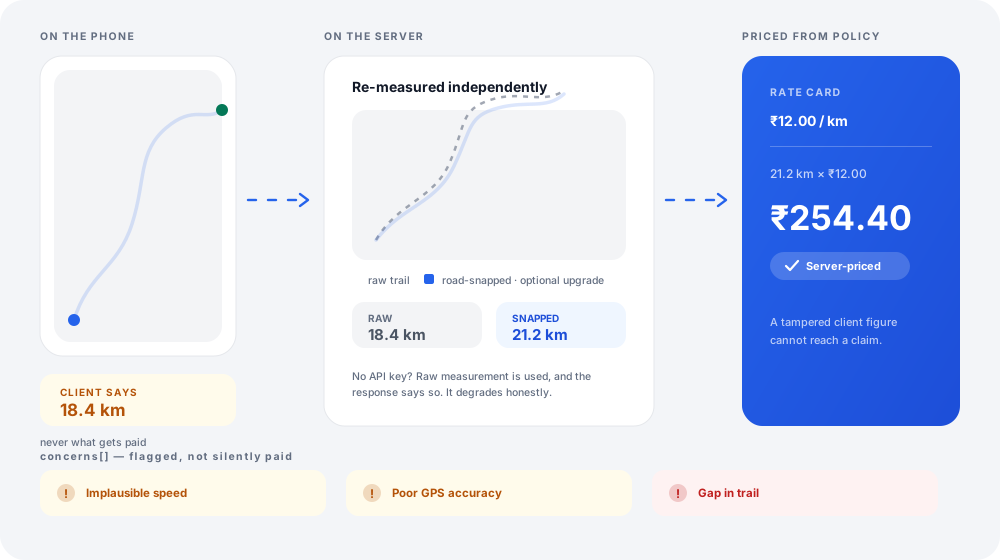
Travel distance measured, not estimated
Trips are GPS-measured, which ends the annual argument about kilometres and removes the need for anyone to adjudicate it.
One Finance approval queue
Everything awaiting Finance in one place, with the supporting document attached to the claim rather than to a forwarded email.
Approval chains that match your delegation
Route by amount, by department or by claim type, so a routine claim does not need the same signature as an unusual one.
Straight into payroll
An approved claim becomes a payroll component in the next run, without a separate instruction to whoever processes salary.
A year-to-date position, always
What has been claimed, against what was declared, against what the limit allows — for any employee, at any point in the year.
See it working
On screen
The distance is measured
Which is a shorter conversation than the one about whether it was really 140 kilometres.
Screenshot pending
Travel claim showing a GPS-measured trip route and calculated distance
Build the demo company with fictional names, salaries and PAN/Aadhaar values first, then drop the image in — see site.config.ts.
Who it’s for
What each person gets out of it
Employees
Claim in the portal and see the remaining limit before claiming.
Finance
One queue, with proof attached. Approved claims flow to payroll.
HR
Declarations, proofs and limits reconcile without a separate sheet.
Managers
Approve team claims against a policy, not against a guess.
Works with
The modules this connects to
These are not integrations. They are the same system reading the same data.
Questions
About claims, travel & reimbursements
How is travel distance measured?
Trips are measured by GPS rather than entered by the claimant, so the distance on the claim is the distance travelled. In practice this removes the most common source of dispute in reimbursement.
Do approved claims need re-entering into payroll?
No. An approved claim becomes a component in the next payroll run directly, which is the point at which most reimbursement processes otherwise break.

See EZER on your own data
See claims, travel & reimbursements on your own data
Tell us your headcount and your states, and we will walk through claims, travel & reimbursements against your actual setup rather than a generic demo account.
- Thirty minutes in the live product. Not a slide deck, and not a recorded video.
- We ask first: how many entities, which states, how many employees, what you run payroll on today.
- Then we show your case — your salary structure, your statutory setup, your locations.
No obligation, no credit card, and we won't add you to a mailing list without asking.